








Full chain inspection escort, strictly adhere to the bottom line of tongue safety
Food safety
Taurine, also known as 2-aminoethanesulfonic acid, is a sulfur-containing non-protein amino acid.Taurine plays an important role in regulating physiological functions, including anti-inflammatory and analgesic effects, maintaining osmotic balance, supporting vision, enhancing immunity, antioxidant activity, and protecting myocardial cells.The Chinese National Food Safety Standard GB 5009.169-2016 specifies methods for determining taurine in various food products, including infant formula, dairy products, beverages, and other food categories.
This application follows Method I of the standard—HPLC with post-column derivatization using o-phthalaldehyde (OPA). Separation is performed using an ion-exchange column, followed by post-column derivatization with OPA, and detection using a fluorescence detector to accurately determine taurine content in beverages.
Quaternary Gradient Pump P40, Autosampler A10C, Column Oven C10, Fluorescence Detector D50, Post-column Derivatization System R10
This method, based on the Chromai Leaps post-column derivatization system and aligned with GB 5009.169-2016, establishes a reliable method for determining taurine in beverages.The taurine calibration curve showed excellent linearity with a correlation coefficient of 1.0000.Retention time repeatability was 0.03%, and peak area repeatability was 0.09%.The detection limit meets national standard requirements, and recovery ranges from 85% to 100%.This method can be used as a reliable analytical approach for determining taurine content in beverages.
Food antioxidants can prevent or delay oxidative deterioration, improve product stability, and extend shelf life. Oxidation not only causes rancidity of oils and fats in food, but also leads to fading, discoloration, and destruction of vitamins, thereby reducing sensory quality and nutritional value. In severe cases, it may even generate harmful substances and cause food poisoning. Therefore, antioxidants should be used appropriately and under proper control. Referring to GB 5009.32-2016 Determination of Nine Antioxidants in Foods, this application developed a method for the determination of nine antioxidants in a branded sunflower oil sample, including propyl gallate (PG), 2,4,5-trihydroxybutyrophenone (THBP), tert-butylhydroquinone (TBHQ), nordihydroguaiaretic acid (NDGA), butylated hydroxyanisole (BHA), 2,6-di-tert-butyl-4-hydroxymethylphenol (Ionox-100), octyl gallate (OG), butylated hydroxytoluene (BHT), and dodecyl gallate (DG).
P60 Solvent Pump, A10C Autosampler, C10 Column Oven, D10 UV Detector
Using the Chromai Leaps UHPLC system and following GB 5009.32-2016 Determination of Nine Antioxidants in Foods, a full methodological evaluation was carried out for the determination of nine antioxidants in food. The method demonstrated excellent linearity, with correlation coefficients all greater than 0.999. The repeatability of retention time was less than 0.15%, and the repeatability of peak area was less than 1.00%. The spike recovery of the nine antioxidants in sunflower oil ranged from 83.72% to 102.20%. The method is simple to operate, stable, and highly sensitive, making it suitable for the determination of nine antioxidants in food samples.
Capsaicin and dihydrocapsaicin are the active components in chili peppers and the main sources of spiciness in chili peppers. Normally, capsaicin or dihydrocapsaicin does not exist in edible vegetable oils. However, the waste cooking oils that have come into contact with chili peppers inevitably contain such components. Therefore, capsaicin - like components can be used as characteristic indicators for identifying gutter oil.
Currently, two national standards for detecting the capsaicin content in edible oils have been issued, namely BJS 201801 "Determination of Capsaicin in Edible Oils" and KJ 202103 "Rapid Detection of Natural Capsaicin in Edible Vegetable Oils - Fluorescent Immunochromatography Method". High - Performance Liquid Chromatography - Tandem Mass Spectrometry for detecting capsaicin has high sensitivity, but the instrument is expensive, the maintenance cost is high, and it requires high professional skills from the testing personnel. The fluorescent immunochromatography method has a high detection efficiency, but the preparation of capsaicin antigen is difficult, or purchasing a kit will increase the testing cost significantly. This application uses ultra - high - performance liquid chromatography equipped with a fluorescence detector, which can effectively determine the contents of capsaicin and dihydrocapsaicin in edible oils, providing a new solution for identifying gutter oil.
Conclusion
This solution uses the Konome high - performance liquid chromatography - fluorescence detector to determine the contents of capsaicin and dihydrocapsaicin in edible oils. This method has a good linear relationship in the concentration range of 0.0625 - 2.5 μg/mL. The limits of quantification of capsaicin and dihydrocapsaicin are 13.4 ng/mL and 17.06 ng/mL, respectively, and the limits of detection are 4.02 ng/mL and 5.12 ng/mL, respectively. There is no interference at the target peaks when testing actual samples. The spiked recoveries of actual samples are 88.5% - 97.1%. Calculated based on a recovery rate of 85%, the limits of detection of capsaicin and dihydrocapsaicin are 0.32 μg/kg and 0.40 μg/kg, respectively, meeting the requirement of the limit of detection of 0.4 μg/kg in KJ 202103 "Rapid Detection of Natural Capsaicin in Edible Vegetable Oils - Fluorescent Immunochromatography Method". This application provides a new and reliable solution for identifying gutter oil.
Aflatoxins, produced by Aspergillus flavus and A. parasiticus, are Class I carcinogens. Among them, aflatoxin B1 (AFB1) is the most toxic, with strong hepatotoxicity and teratogenicity. The current Chinese standard GB 5009.22-2016 specifies the detection methods for aflatoxins in foods, including isotope dilution liquid chromatography-tandem mass spectrometry (Method 1) and high-performance liquid chromatography-fluorescence detection (HPLC-FLD) (Method 2: pre-column derivation, Method 3: post-column derivation).
Compared with pre-column derivation and post-column chemical reagent derivation, post-column photochemical derivation eliminates manual sample pretreatment, avoids contamination of the chromatographic system by derivatization reagents, and offers advantages such as simple system configuration and low device cost. This protocol develops a post-column photochemical derivation method for analyzing aflatoxins B1, B2, G1, and G2 using the Chromai Leaps UHPLC-fluorescence detection system, in accordance with Method 3 of GB 5009.22-2016. The method's limits of detection (LOD) and quantitation (LOQ) fully meet the requirements of current national standards, providing a simple, efficient, specific, sensitive, and cost-effective analytical solution for aflatoxins.

This application demonstrates a method for simultaneous determination of aflatoxins B1, B2, G1, and G2 in foods using Chromai UHPLC-fluorescence detector with post-column photochemical derivatization. The method features good linearity, reproducibility, and sensitivity, with LOD/LOQ meeting national standard requirements. Compared to other derivatization methods, photochemical derivatization offers simpler equipment, lower cost, and avoids chemical reagent damage or manual operation risks, making it a superior solution for aflatoxin analysis.
Sugars are the primary raw and auxiliary materials in the food industry, and are also one of the main components of most food products. The National Health Commission and the State Administration for Market Regulation jointly issued GB 28050-2025, the National Food Safety Standard for Nutrition Labeling of Pre-packaged Foods, which replaces GB 28050-2011 and comes into effect on March 16, 2027. The key revision mandatorily requires the labeling of fatty acid content as well as specific values for fructose, glucose, sucrose, maltose, and lactose. It also mandates the statement "Children and adolescents should avoid excessive intake of salt, oil, and sugar," thereby improving consumers' precise understanding of food nutritional components.
This application note references Method 1 of GB 5009.8-2023 (National Food Safety Standard: Determination of Fructose, Glucose, Sucrose, Maltose, and Lactose in Food), using the Chromai Ultra-High Performance Liquid Chromatograph (UHPLC) with amino column separation and a differential refractive index (RID) detector. This method enables efficient and accurate determination of sugar content in food.
This application note demonstrates that the Chromai Leaps UHPLC system, equipped with a Lotus NH? amino column and D60L differential refractive index detector, provides a robust, accurate, and highly repeatable solution for the simultaneous determination of five sugars (fructose, glucose, sucrose, maltose, and lactose) in food matrices.The Chromai UHPLC platform offers food testing laboratories an efficient, reliable, and standards-compliant analytical tool for routine sugar quantification.
Amino acids in tea play a critical role in the fresh and sweet taste of tea infusion and are highly positively correlated with tea quality. During tea processing, amino acids undergo Maillard reactions, Strecker degradation, and other thermal reactions to form aroma compounds such as aldehydes, which in turn affect the final quality of tea. Therefore, amino acids are key indicators in tea quality evaluation. In this application, the Leaps AA5000 Amino Acid Analyzer was used in accordance with GB/T 30987-2020 Determination of Free Amino Acids in Plants to determine the contents of 21 amino acids in different tea samples. The method features a high degree of automation, good stability, and minimal matrix interference, making it suitable for the determination of amino acids in plant samples.

Conclusion
Using the Chromai Leaps AA5000 Amino Acid Analyzer together with dedicated reagent kits, a method for the determination of 21 amino acids was successfully established. The correlation coefficients for all 21 amino acids were greater than 0.9998, the repeatability of retention time was less than 0.4%, and the repeatability of peak area was less than 1.0%. The method offers a high level of automation, excellent stability, and a simple, user-friendly workflow, enabling accurate and rapid amino acid analysis.
Currently, pesticide residues in vegetables are mainly from carbamates and organophosphates. Common carbamate pesticides include aldicarb sulfoxide, aldicarb sulfone, methomyl, carbofuran, etc. This type of pesticide inhibits acetylcholinesterase in the body, preventing the breakdown of acetylcholine, leading to its accumulation in tissues and causing poisoning.
Reported methods for detecting carbamate pesticides mainly include chromatography, spectrophotometry, and mass spectrometry. Spectrophotometry uses spectral characteristics for qualitative and quantitative analysis of known substances. Although simple, it is susceptible to interference. Gas chromatography-mass spectrometry (GC-MS) and liquid chromatography-mass spectrometry (LC-MS) can also be used, offering high sensitivity but requiring complex operations and expensive instruments. This application refers to GB23200.112-2018 National Food Safety Standard — Determination of 9 Carbamate Pesticides and Their Metabolites in Plant-Based Foods by Liquid Chromatography–Post-Column Derivatization Method. The method combines liquid chromatography with post-column derivatization and fluorescence detection, which improves sensitivity and provides strong anti-interference capability.
In this application, the Chromai LEAPS UHPLC system, coupled with the R10 column and post-column derivatization device, was used to determine the residues of nine carbamate pesticides and their metabolites in plant-derived foods. All compounds showed correlation coefficients greater than 0.9999 within the linear range; the RSD% of retention times was less than 0.15%, and the RSD% of peak areas was less than 2.0%. The detection limits were below 0.006?μg/mL. This method is highly automated, stable, and sensitive, with simple operational procedures, making it suitable for determining carbamate pesticide residues in plant-derived foods.
Fat-soluble vitamins A, D, and E are essential nutrients for maintaining normal metabolism and functions of the human body. Fortified foods and formula foods for special medical purposes are important ways to supplement vitamins. Accurate determination of their vitamin content is of great significance for scientific dietary guidance and food safety assurance. However, in practical analysis, due to the complex matrix of such samples, conventional chromatographic analysis suffers from significant interference, requiring cumbersome sample pretreatment procedures.
The National Food Safety Standard GB 5009.296-2023 Determination of Vitamin D in Foods has incorporated the online column-switching reversed-phase liquid chromatography method as a standard approach, providing a better reference for the determination of vitamin D. Building on this, Chromai Technology has introduced online solid-phase extraction (Online SPE) technology into two-dimensional liquid chromatography, realizing technological upgrading of the sample pretreatment process and delivering a substantial improvement in analytical efficiency for customer laboratories.
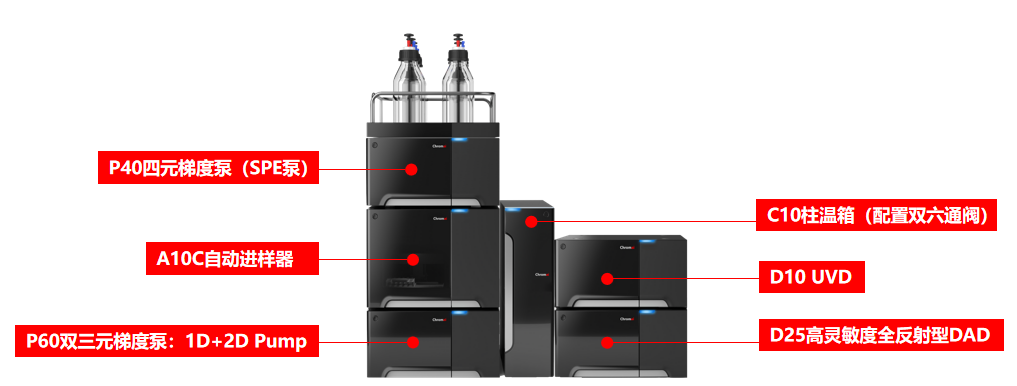
Chromai Online SPE-2DLC
Vitamin ADE Analysis System
This solution refers to the group standard T/SHFCA 002-2024, and establishes an analytical method for the determination of vitamins A, D and E in formula milk powder using Chromai online solid-phase extraction coupled with heart-cutting two-dimensional liquid chromatography.
The method employs Chromai dedicated columns for vitamin ADE analysis, enabling excellent separation of vitamin A, four isomers of vitamin E, vitamin D? and D?. The application of online solid-phase extraction technology greatly simplifies the sample pretreatment procedure, thereby improving detection efficiency and reducing manual errors.
With Chromai’s high-sensitivity total-reflection diode array detector, accurate quantitative analysis of low-level vitamin D can be achieved. Finally, this method has demonstrated satisfactory reproducibility and stability in preliminary robustness tests, and can be widely applied as an efficient and reliable approach for the analysis of vitamins A, D and E in infant formula milk powder.
Ascorbyl palmitate is an efficient fat-soluble antioxidant and nutritional fortifier. It has been recognized by the World Health Organization as a safe and non-toxic food additive, and it is also the only antioxidant permitted for use in infant foods in China. However, excessive use may lead to adverse effects such as gastrointestinal irritation, tooth damage, and elevated blood pressure. Therefore, it is necessary to establish a reliable method for the determination of ascorbyl palmitate in food. Referring to GB 5009.308-2025 Determination of Ascorbyl Palmitate in Foods, this application determined the content of ascorbyl palmitate in branded cola and milk powder samples.
Conclusion
Using the Leaps UHPLC system and following GB 5009.308-2025 Determination of Ascorbyl Palmitate in Foods, a methodological evaluation was performed. The method showed excellent linearity, with a correlation coefficient greater than 0.9999. The repeatability of retention time was 0.11%, and the repeatability of peak area was 0.20%. At the spiking level corresponding to the limit of quantification, the recovery was 87.0% for milk powder and 85.5% for cola. The method is simple, stable, and highly sensitive, fully meeting the requirements for the determination of ascorbyl palmitate in food.
During food processing and storage, organic acids play a vital compositional role. They have a significant impact on the color, aroma, and taste of food. Moreover, a higher content of organic acids in food leads to a lower pH, which helps preserve the product. Therefore, determining the content of organic acids in food is of great importance. In this application, the Leaps Duo Parallel Liquid Chromatography System was used to establish a highly efficient method for determining the content of seven organic acids in food. This method allows simultaneous analysis of all seven compounds, reducing analysis time and significantly improving work efficiency.
Conclusion
In this application, the Chromai Leaps Duo Parallel Liquid Chromatography System was used to establish a rapid method for determining the content of seven organic acids in food. Tests were performed for the standard curve, detection limit, and precision, all of which met the requirements of the national standard for the determination of organic acids. The Chromai Leaps Duo Dual-Injection High-Performance Liquid Chromatography System enables simultaneous analysis of different items from the same sample, reducing analysis time by half and significantly improving work efficiency.