






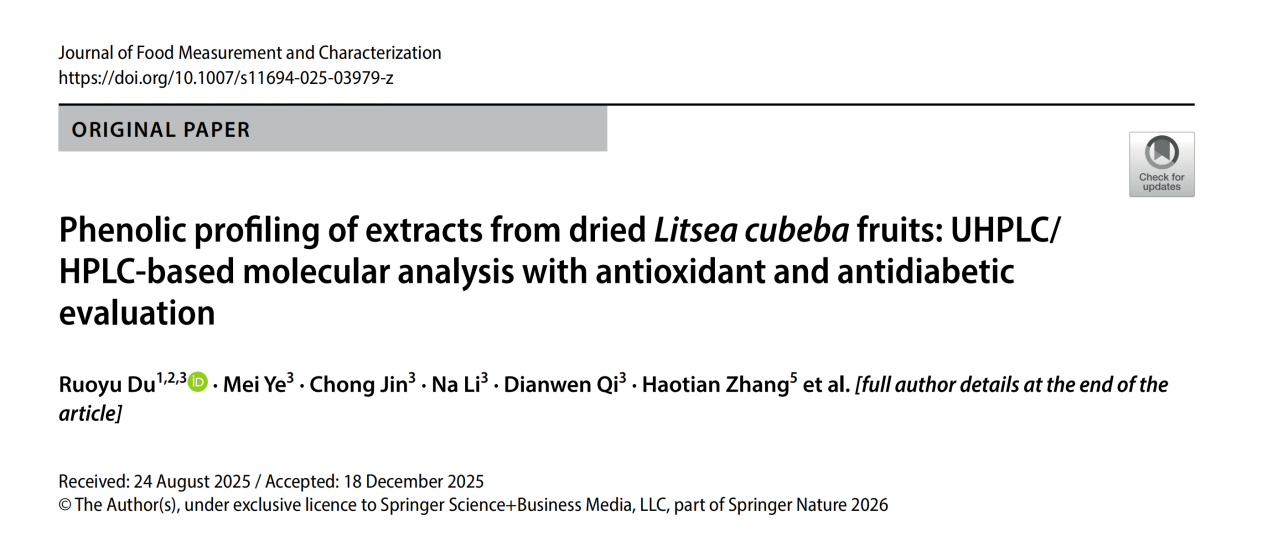
Recently, a research team led by Dr. Du Ruoyu from the College of Environment and Resources, Chongqing Technology and Business University, published a significant study titled "Phenolic profiling of extracts from dried Litsea cubeba fruits: UHPLC/HPLC-based molecular analysis with antioxidant and antidiabetic evaluation" in the international journal "Journal of Food Measurement and Characterization". This study confirmed for the first time that Litsea cubeba fruit peel (LCF) is a high-quality biomass resource with multiple functions, and its extract exhibits excellent antioxidant and hypoglycemic potential. Chromai Frontier UHPLC served as the core analytical equipment throughout the research, and Chromai engineer Zhang Haotian also participated in the study as the fifth author.
Paper Link: https://link.springer.com/article/10.1007/s11694-025-03979-z
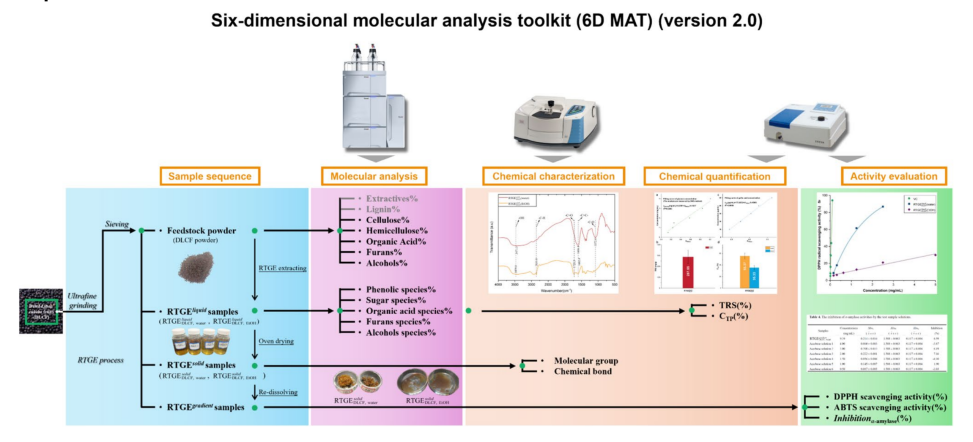
This study found that the extractable content of Litsea cubeba fruit peel is as high as 56.55 wt%, providing abundant precursors for bioactive compounds and industrial raw materials; the RTGE extract in its aqueous solution, leveraging lignin-derived catechol groups and a glycerol-phenolic synergy of 78.96 mg/g, exhibits significant antioxidant activity and α-amylase inhibitory capacity (key for hypoglycemic effects). Meanwhile, the ethanol extraction method achieved nearly complete extraction with 99.94% efficiency, laying the foundation for industrial application. A key technical highlight of the study is the establishment of a UHPLC/HPLC molecular analysis toolkit independent of mass spectrometry, capable of quantitatively analyzing 60 phytochemicals and accurately detecting hydrophilic phenolic compounds. The analysis platform built by the team integrates UV and refractive index detectors, enabling qualitative and quantitative identification of 17 phenolic and 12 non-phenolic compounds, boasting high sensitivity (detection limit 0.02–0.89 μg/mL) and good linearity (R2 > 0.997). Furthermore, the study upgraded the six-dimensional molecular analysis toolkit (6D MAT 2.0), creating a full-process system from sample extraction - fractionation - molecular profiling - qualitative characterization - quantitative detection - bioactivity assessment, achieving traceability linking molecular information and activity data of biomass raw materials, forming a closed loop of structure-activity relationships.
In the specific detection of phenolic substances, the Chromai Frontier UHPLC completed the core detection work with its stable performance. The research team also determined precise chromatographic conditions, including the Lotus C18 column, a column temperature of 30°C, and a mobile phase system of 0.2% acetic acid aqueous solution - methanol, providing a replicable method for the accurate detection of phenolic compounds.
Through detection with the Chromai Frontier UHPLC instrument, the research team successfully identified 17 phenolic substances from the RTGE(liquid) sample, including 14 water-soluble phenolics (gallic acid, protocatechuic acid, chlorogenic acid, rutin, etc.) and 3 ethanol-soluble phenolics (salicylic acid, kaempferol, luteolin), clearly analyzing the composition of phenolic substances in Litsea cubeba fruit peel, providing a precise material basis for further exploring its bioactive value.
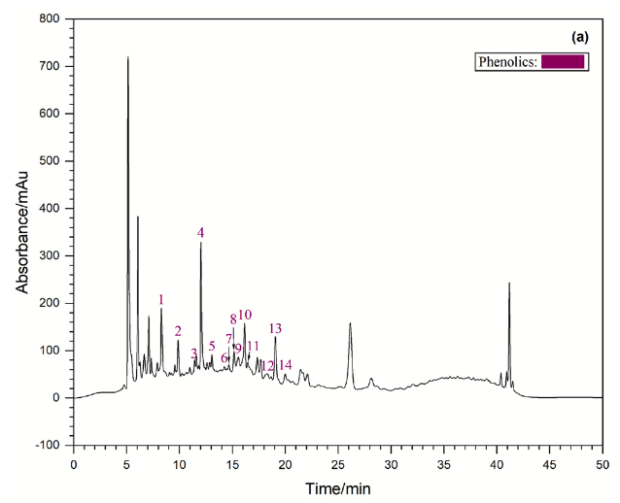
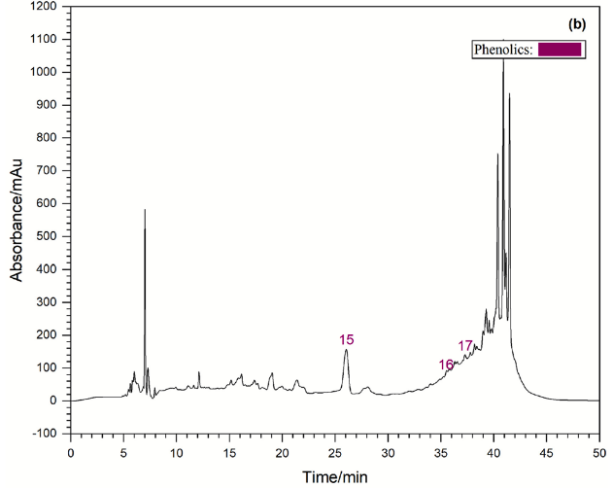
Water-soluble phenolic compounds (Figure a, Nos. 1-14) are: 1. Gallic acid; 2. Procyanidin B1; 3. Epigallocatechin; 4. Protocatechuic acid; 5. Chlorogenic acid; 6. Epicatechin; 7. Mandelic acid; 8. p-Hydroxybenzoic acid; 9. Caffeic acid; 10. 4-Hydroxybenzaldehyde; 11. Syringaldehyde; 12. 4-Hydroxycinnamic acid; 13. Phenol; 14. Rutin. Ethanol-soluble phenolics (Figure b, Nos. 15-17) are: 15. Salicylic acid; 16. Kaempferol; 17. Luteolin
This research not only uncovered the significant development value of Litsea cubeba fruit peel in the fields of functional foods and biomass chemicals but also validated the core role of UHPLC/HPLC molecular analysis technology in natural product research, providing a new technological paradigm for the in-depth exploration of natural biomass resources.